




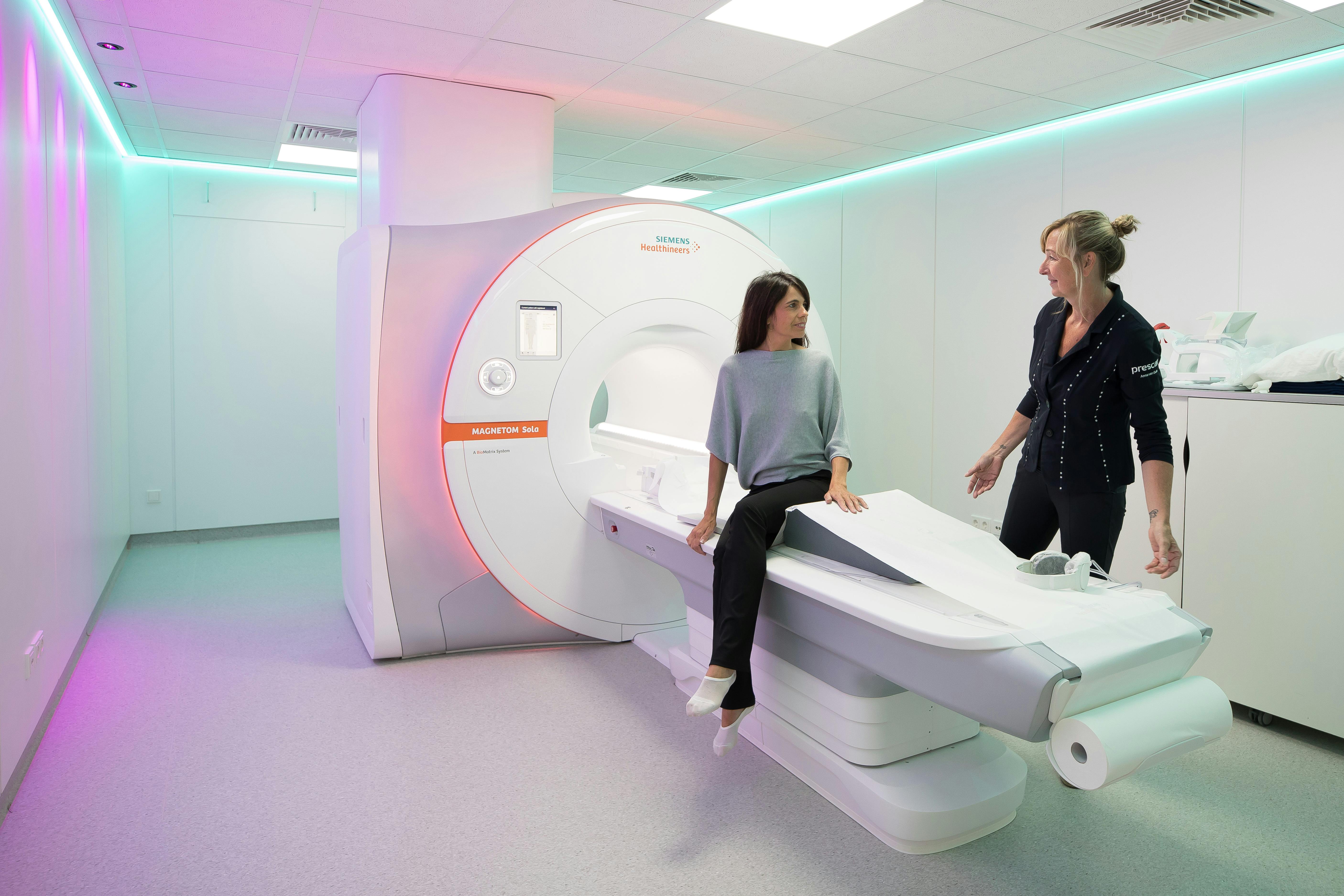
1. Ring vs. tunnel
The appearance of a CT scanner and MRI scanner are very similar. However, there is a big difference. A CT scanner involves a ring through which you are moved. With an MRI scanner, you are moved into a tunnel. People who suffer from claustrophobia may have difficulty with an MRI scan. However, it is not impossible to undergo an MRI scan with claustrophobia. Radiologist Cristina Dowling has compiled several tips to stay calm during an MRI scan.
2. Sound
The sound is also a significant difference between an MRI scan and a CT scan. Unlike an MRI scanner, a CT scanner does not make noise. During an MRI scan, there is sound. You will receive headphones, possibly with (your favorite) music, which helps to make the loud ticking sound feel calmer during the examination.
3. Time
A CT scan generally goes a bit faster than an MRI scan. A CT scan usually takes 5 to 15 minutes, while an MRI scan can take up to half an hour or longer. For this reason, a CT scan is often chosen in urgent situations. An MRI scan provides a more detailed view of tissues, among other things. The situation can therefore determine which scan method is selected.
Our innovative custom health check ensures insight into your health within a single day. Our specialized doctors with years of experience take all the time you need. The best equipment, no referral required, and short waiting times.
4. Soft Tissues
On an MRI scan, parts of the body that contain hydrogen atoms are more visible than parts that do not contain these atoms. Tissue and organs contain more water than bones and are therefore more visible on an MRI scan. On an MRI scan, the brain, heart, spinal cord, nerves, muscles, tendons, and organs in the abdomen are generally well displayed. On a CT scan, the brain, (arteries), lungs, abdominal organs, and bones are clearly visible.
5. X-ray vs. Magnetic Field
The last major difference between the two devices is that a CT scanner uses X-rays, and an MRI scanner uses radio waves and a strong magnetic field. Because of the strong magnetic field of the MRI scanner, it's also important that no metal objects are taken into the scanner. Consider zippers on clothing, underwire in a bra, piercings, or metal in the body. These metal objects can move or become disrupted by the magnetic force. The magnetic field is otherwise not harmful to the body. This is also the main reason why at Prescan we choose an MRI scan instead of a CT scan. We do not want to unnecessarily expose you to X-rays. A CT scan also uses more X-rays than an X-ray image. This radiation is the reason why doctors often only opt for a CT scan when it is really unavoidable.
At Prescan, we exclusively conduct MRI scans. You can find these in our Core, Pro or Elite package. Additionally, we also conduct targeted MRI scans.
Quick insight into the status of your health.
A bodyscan – also known as a health check or total body scan – is a preventive medical health examination, aimed at detecting risk factors and (possible) conditions. Where and when you want it, without a referral. A bodyscan consists of five targeted MRI scans of: skull & brain, neck vessels, chest, upper abdomen, and lower abdomen. Not all risk factors are visible on an MRI scan. Therefore, we also offer extensive examination programs including cardiological, dermatological, and laboratory examinations. All examinations are assessed by medical specialists. You receive the results immediately, and your MRI images are always accessible and easy to share. This way, you gain immediate insight into your health.


